KB0004: The thinkcell add-in is missing in PowerPoint
- Home
- Resources
- Knowledge base
- KB0004
If you can't find thinkcell in PowerPoint, there are several possible causes. Please try the following solutions in sequence:
-
Check if thinkcell is already running.
On the PowerPoint ribbon, if the thinkcell group appears on the Insert tab, thinkcell is running.
If the thinkcell tab contains no commands, or if the thinkcell tab is missing entirely, reset the tab (see KB0243).
If the thinkcell group is missing from the Insert tab, proceed with the subsequent solutions.

-
Restart your computer.
To ensure that no hidden or hanging PowerPoint or Excel processes remain stuck on your machine, please restart your computer.
Alternatively, close all respective processes. Read more
If using Windows:- Open the Windows Task Manager and check for remaining
POWERPNT.EXEorEXCEL.EXEprocesses.- Windows Vista and Windows 7: Task Manager → Processes.
- Windows 8, Windows 8.1 and Windows 10: Task Manager → More Details → Details.
- End these processes.
Right-click the PowerPoint and Excel icons in the dock and select Quit. Alternatively, open PowerPoint and Excel and press Cmd ⌘+Q.
- Open the Windows Task Manager and check for remaining
-
Activate thinkcell from within Excel.
Is there a thinkcell group on the Insert tab of Excel's ribbon? If so, try thinkcell's built-in repair mechanism to enable it in PowerPoint, too:
- Restart your computer (alternatively you can stop all
POWERPNT.EXEandEXCEL.EXEprocesses as explained above in 2. Restart your computer). - Open Excel, and select a cell range (e.g., select A1:C3).
- Click on Insert > thinkcell > Charts > Stacked
- After PowerPoint opens, open a file and try to click onto a slide to place the chart.
- Restart your computer (alternatively you can stop all
-
Check if thinkcell was automatically disabled.
Verify that thinkcell was not automatically disabled as described in KB0005.
-
If using Windows, check PowerPoint's security settings.
Verify that the security settings in PowerPoint are not preventing thinkcell from being loaded as explained in KB0187.
-
If using Windows, check if you are using a Desktop Apps version of Office.
Check if the Office installation is called Microsoft Office Desktop Apps. If so, please follow the instructions in our knowledge base article KB0226.
-
If using Mac, check whether your Office version has the necessary updates.
You can find your Office version by opening PowerPoint and in the Mac menu bar selecting PowerPoint > About PowerPoint. If the build number is lower than "16.8 (171111)" please update Office following the steps in Microsoft's support page: Update Office for Mac automatically (Note: we recommend not switching to the Insider channel). Quit and restart PowerPoint and Excel after this.
-
If using Mac, make sure that security settings are not preventing add-ins from loading.
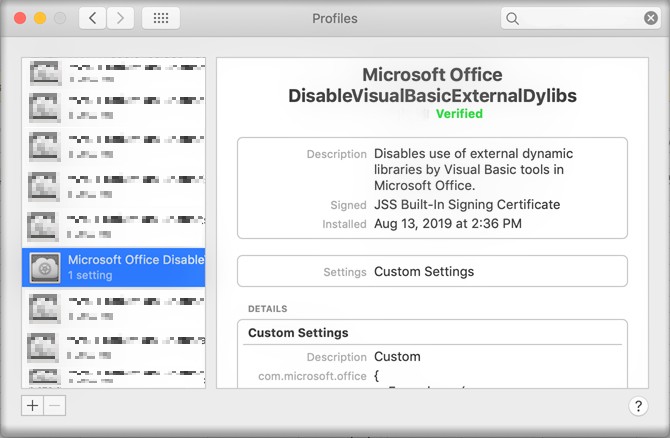
Check your profile settings by going to System Preferences > Profiles:
If "DisableVisualBasicExternalDylibs" or "VisualBasicEntirelyDisabled" are set to "TRUE" or "YES", you or your IT must change those settings to enable Visual Basic so that thinkcell can run correctly.
Do note that the names of profile settings can vary, as they depend on the program used to distribute them as well as any manual changes that may have been made.
-
Reinstall thinkcell.
Please download the current thinkcell version from our download web page.
-
Contact Support.
If thinkcell still does not start correctly, please contact our support team and attach the thinkcell log files. Because thinkcell is not running, the log files must be collected and attached manually. Please follow these steps:
If using Windows:
-
Open a new File Explorer window.
-
In the address field, enter
%LOCALAPPDATA%\think-cell. Select Enter.Alternatively, you can open the
think-cellfolder by browsing the directory: Read moreThe full default filepath is
C:\Users\USERNAME\AppData\Local\think-cell. ReplaceUSERNAMEwith your username.If you can't find this folder, it's probably hidden. To show hidden items, in File Explorer, select one of the following:
- Windows 7: Organize > Folder and search options > View > Show hidden files and folders
- Windows 8, Windows 8.1, and Windows 10: View > Show/hide > Hidden Items
- Windows 11: View > Show > Hidden Items
-
Send all the files in the
think-cellfolder that end inlogto our support team. These files may include any of the following:-
EXCEL_log.log -
POWERPNT_log.log -
ppttc_log.log -
setup_think-cell_VERSION_log.log -
tcasr_log.log -
tcindex_log.log -
tcmail_log.log -
tcrunxl_log.log -
tcupdate_log.log
Additionally, if thinkcell is active, please send us a screenshot of the About thinkcell dialog. To open the About thinkcell dialog, on the PowerPoint or Excel ribbon, select Insert > thinkcell > Tools

-
If using Mac:
- Open a new Finder window, then select Go > Go to Folder.
- Type in
/Users/USERNAME/Library/Application Support/think-cell. ReplaceUSERNAMEwith your username. - Press Enter.
-
Open the subfolder
host_*, where*is a string of random characters. -
Please send all files with the extension
.logcontained in this folder to our support team. These files may include any of the following:POWERPNT_log.log,EXCEL_log.log,TCMAIL_log.log,TCUPDATE_log.log,TCRUNXL_log.log,PPTTC_log.log,setup_think-cell_xxxxx_log.log.
-


